
When Do Babies Roll? (And How To Help Without Forcing It)
By Ali Day, Paediatric Physiotherapist and mum of two | Author of The Baby Playbook
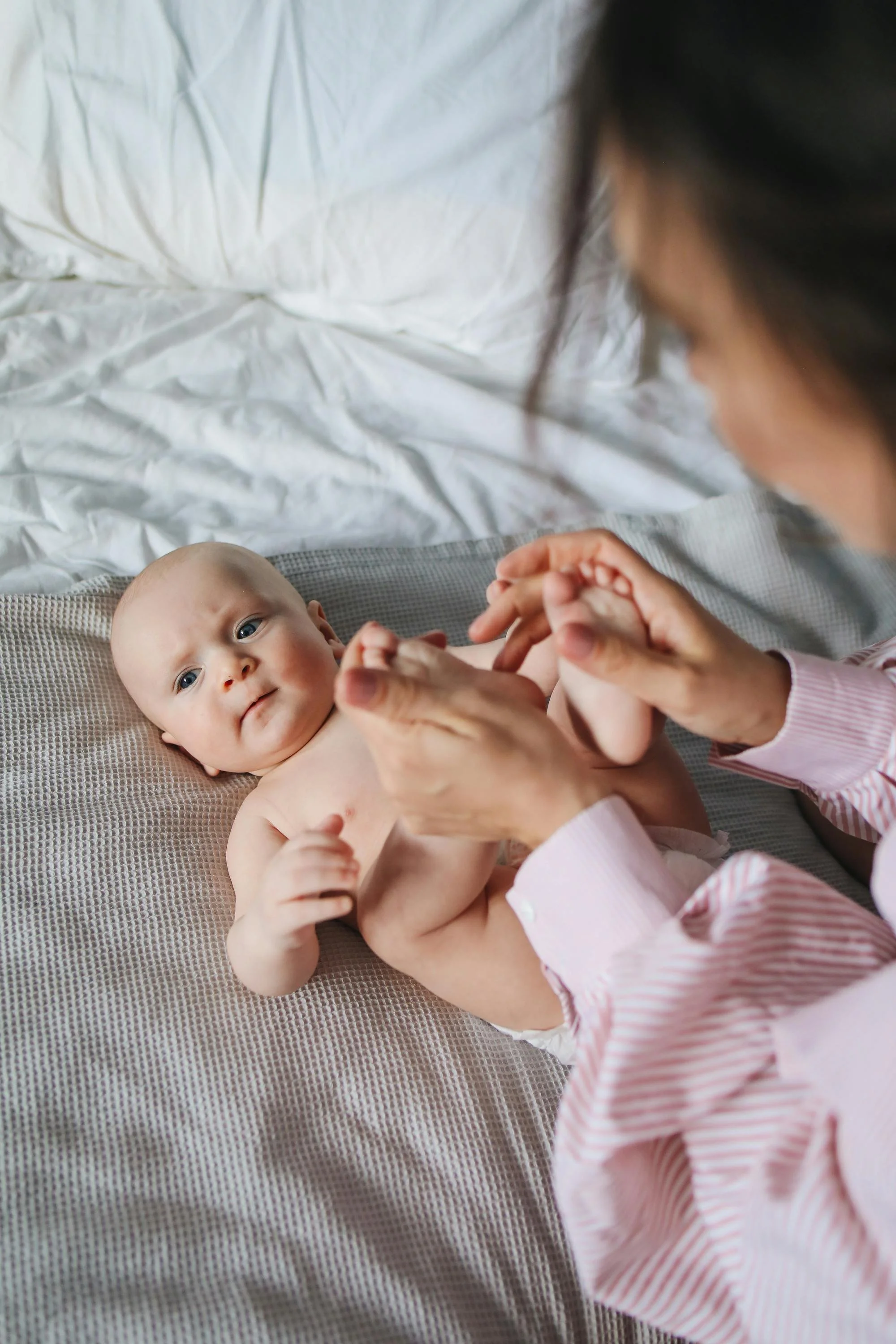
A gorgeous image of a mum helping lift their baby’s legs up to help rolling
When do babies start rolling?
One of the most common questions new parents ask is:
when do babies roll?
50-90% of babies roll between 6 and 9 months, based on the developmental ranges outlined in the Alberta Infant Motor Scale (AIMS).
Some babies may roll earlier, and some later. This variation is completely normal and expected in the general population!
If you are feeling unsure about what is typical and how to support your baby at each stage, this is exactly why I created The Baby Playbook (also available on Amazon.com here). It gives you a clear, step by step approach to milestones using simple, purposeful play.
What is the rolling milestone?
Rolling is one of the first big whole-body movements your baby will achieve and really gets their journey of mobility and movement started!
It requires:
Head and neck strength
Core activation
Weight shifting between arms
Coordination between both sides of the body
The beauty of rolling is that these are also the foundations for later skills like sitting and crawling.
Signs your baby is getting ready to roll
Before your baby rolls, you may notice smaller movements that build the foundation.
Look for:
Bringing hands together at midline
Reaching across their body
Lifting their head during tummy time
Kicking with more control
Shifting weight side to side
These are all important signs that your baby is developing the strength and coordination needed to roll.
Why some babies roll later
If you are worried about a baby not rolling at 7-9 months, it is important to look at the bigger picture.
Some common reasons for variation include:
Less time on the floor
More time in supportive devices
Individual differences in strength and temperament
Preference for certain positions
Development is not a straight line, and babies often progress quickly once the correct foundations are in place.
How to help your baby roll (without forcing it)
You might be wondering how to help baby roll, or whether you should be actively teaching the movement.
The most effective approach is purposeful play.
Purposeful play means creating simple, intentional opportunities for your baby to move, explore and build strength naturally. Allowing lots of free floor play with a few intentional toys placed to encourage movement can be enough to get babies rotating and rolling. Other more purposeful play ideas include;
1. Encourage reaching across the body
Place toys slightly to the side instead of directly above your baby.
This encourages rotation, which is essential for rolling.
2. Use side lying play
Side lying is one of the most effective positions for early movement. You can place a rolled towel behind their back and toys in front of them to play in this position.
It helps your baby:
Shift weight
Bring hands together
Explore movement in a supported way
3. Prioritise floor time
Babies learn to move by moving.
Regular floor time gives your baby the opportunity to practice and build strength over time.
4. Support, do not force
It can be tempting to roll your baby through the movement.
However, repeatedly placing them into positions they are not ready for can:
Reduce their opportunity to problem solve
Limit muscle activation
Create frustration
Your role is to set-up, guide and support, not force!
Why purposeful play matters for rolling
Purposeful play is not about doing more. It is about doing the right things in a simple, consistent way.
Through purposeful play, your baby learns by:
Exploring
Repeating movements
Building strength gradually
This aligns with how babies naturally develop motor skills plus can give them adequate opportunity to explore and learn if it might not be in their nature to do so independently.
When should you be concerned?
While there is a wide range of normal, it may be helpful to seek support if:
Your baby shows limited movement by around 6 to 7 months
There is a strong preference to one side
Your baby struggles with head control
You feel unsure or concerned, trust your gut
Early guidance is often simple and very effective.
How rolling supports future milestones
Rolling is not just a milestone on its own.
It supports:
Sitting
Transitions between positions
Crawling
Overall coordination
Focusing on the foundations will support all future development.
A gentle reminder
If your baby is not rolling yet, it does not mean they are behind.
Development is not a race.
What matters most is giving your baby opportunities to move, explore and build strength in a way that feels safe and supported.
Frequently asked questions
When do babies roll from tummy to back?
Many babies first roll from tummy to back, often earlier than back to tummy. This can happen as they build strength in tummy time, but timing varies.
When do babies roll from back to tummy?
Rolling from back to tummy usually requires more strength and coordination, so it often happens later within the 6 to 9 month range.
Should I be worried if my baby is not rolling at 6 months?
Not necessarily. There is a wide range of normal. Look at your baby’s overall movement, strength and opportunities for floor play rather than focusing on one milestone alone. If they are heading towards 7-9 months and not looking interested in, or trying to, roll to their side it might be a good idea to check in with your chosen health professional.
How can I help my baby roll naturally?
Focus on purposeful play:
Encourage reaching
Use side lying
Allow floor time
Avoid forcing movements
These build the foundations needed for rolling.
Does tummy time help with rolling?
Yes. Tummy time helps build the strength needed for rolling, but it does not have to be done only on the floor. Variations like chest to chest and supported positions also help and can be seen in my blog on 'Why does my baby hate tummy time.’
Want a simple plan for every milestone?
If you are looking for clear guidance without the overwhelm, The Baby Playbook (or for overseas buyers click here) walks you through exactly how to support your baby’s development through purposeful play.
You can also find more simple, practical ideas on Little Ones Physio Instagram to support your baby in everyday moments.
Disclaimer: This page is intended to be educational and informative only and should not be taken as, or replace, individual medical advice. This should act as a guide only. Always consult with a healthcare professional for accurate diagnosis and personalised treatment if you have any concerns with your little one.
Every child is unique and should be assessed individually.
References
Piper, M. C., & Darrah, J. (1994). Motor Assessment of the Developing Infant. Alberta Infant Motor Scale (AIMS). Saunders.